Work-Integrated Career Pathway

Accelerated AI Engineering Immersive

Most engineers learn AI on the side and hope it sticks. This program puts you in a paid apprenticeship while you build production-ready AI skills from the ground up.

$14k
Net Earnings
14 months
AI Certificate
Three friends laughing and playing video games indoors, each holding a game controller.
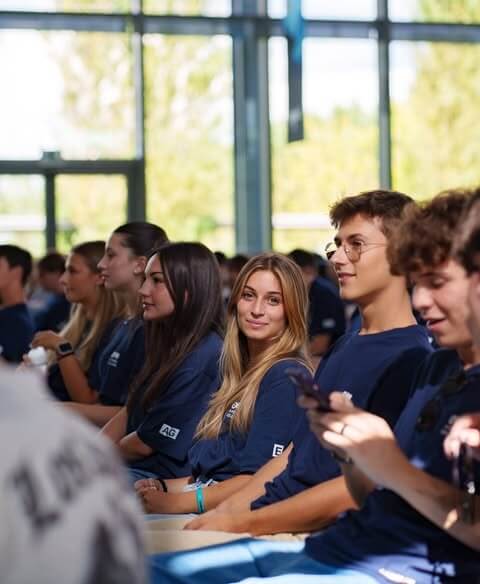
A group of young people sitting indoors in rows, wearing matching navy blue shirts, with one woman looking directly at the camera.
Group of young people enjoying an outdoor picnic around a long wooden table with pizzas and drinks at sunset.

Overview

Excellence Icon Eduhub X Webflow Template | Brix Template

Program Length

14 months

Accountability Icon Eduhub X Webflow Template | Brix Template

Study Load

20hrs/week

Impact Icon Eduhub X Webflow Template | Brix Template

Work Load

20hrs/week

Respect Icon Eduhub X Webflow Template | Brix Template

Delivery Mode

Flexible, on-demand curriculum
Weekly live sessions
Personalized mentor feedback

Passion Icon Eduhub X Webflow Template | Brix Template

Faculty Ratio

8:1 Student to Instructor Ratio
1:1 Student to Mentor Ratio

Passion Icon Eduhub X Webflow Template | Brix Template

Costs

Tuition: $14,900
Scholarship: $3,000
Earnings: $25,900
Net Monthly Income: $1,000

Passion Icon Eduhub X Webflow Template | Brix Template

Skill Level

Early-career Software Engineers

Passion Icon Eduhub X Webflow Template | Brix Template

Start Dates

The first Monday of every month

Integrity Icon Eduhub X Webflow Template | Brix Template

Credential

Artificial Intelligence Certificate

Why Artificial Intelligence

AI Is No Longer a Specialty

It is becoming the foundation of how software gets built, how decisions get made, and how organizations operate. The engineers and researchers who understand how these systems actually work, not just how to use them, are in extraordinary demand. Graduates pursue AI roles with average salaries ranging from $100,000 to $135,000.

AI Engineer

$102,000 avg. salary

Designs, builds, and deploys intelligent systems that automate decisions and power modern applications.

Machine Learning Engineer

$112,000 avg. salary

Builds and maintains the models and pipelines that turn raw data into production-ready AI systems.

AI Research Analyst

$100,000 avg. salary

Evaluates AI tools, interprets model outputs, and translates findings into actionable organizational decisions.


What You'll Learn

You already know how to build software. This program adds AI and data science to that foundation. Two phases, 14 months, and an apprenticeship running the entire time.

Program Outline


14 months

Project-based learning

Flexible, online format

Work-integrated design

Industry mentorship

Instruction from a practitioner

Phase 1: Artificial Intelligence
  • Introduction to Data Science
    Explore data analysis and visualization using Python, with a focus on statistical measures, the pandas library, and tools like Seaborn and Matplotlib. You'll work with qualitative, quantitative, and multivariate data, finishing with a full exploratory data analysis project. Catalog→
  • Introduction to SQL
    Build skills in SQL, data engineering, and database administration alongside core mathematics, probability, and statistics for data science. You'll write queries, explore table relations, and finish with a project applying SQL within a Python environment to solve a real data problem. Catalog→
  • Cloud Computing, Generative AI, and Dashboards
    Dive into distributed data processing using PySpark to bridge Python, SQL, and Spark at scale. You'll work with NumPy, Pandas, and visualization libraries to surface insights from large datasets, finishing with an AI-enhanced dashboard built around interactive data storytelling. Catalog→
  • Inferential Statistics
    Build the theory and practical skills to perform statistical inference using Python. You'll work with probability distributions, confidence intervals, and hypothesis testing across diverse data types, finishing with a project that applies inferential methods to draw meaningful conclusions from real data. Catalog→
  • Regression
    Learn to build and evaluate regression models, from linear and multiple linear approaches to regularized techniques like Lasso and Ridge. You'll work through diagnostics, transformations, and the bias-variance tradeoff, finishing with a robust regression model built on a real-world dataset. Catalog→
  • Introduction to Machine Learning
    Learn the fundamentals of AI and machine learning through a hands-on, model-driven approach. You'll build and evaluate models including logistic regression, decision trees, and support vector machines, finishing with a project that takes a real-world task through the full data science pipeline. Catalog→
  • Machine Learning with Scikit-Learn
    Apply machine learning concepts in practice using Scikit-Learn, working with both supervised and unsupervised models. You'll explore k-Nearest Neighbors, recommender systems, k-means clustering, and PCA, finishing with a project that demonstrates classification and clustering on real data. Catalog→
  • Natural Language Processing, Time Series, and Neural Networks
    Build advanced models across three key domains: NLP, time series analysis, and neural networks. You'll apply text vectorization, temporal modeling, and Keras-based implementation, finishing with three distinct models covering language, time series, and foundational neural network tasks. Catalog→
  • Neural Networks and Similar Models
    Advance your deep learning skills by building CNNs, RNNs, and transformer architectures including BERT. You'll apply normalization, regularization, and statistical principles to optimize model performance, finishing with a hands-on project that integrates these techniques into an advanced neural network application. Catalog→
  • Large Language Models
    Learn to deploy, fine-tune, and maintain large language models in real-world environments using the open-source MLOps stack. You'll develop expertise in data-centric workflows, prompt engineering, and model iteration, preparing you to integrate and operate advanced AI systems in production settings. Catalog→
Phase 2: Capstone
  • AI Engineering Capstone
    Bring together everything from the program to solve real-world problems using both supervised and unsupervised methods, including modern LLM workflows. You'll scope problems, select data, choose modeling approaches, and communicate results tied to stakeholder needs, finishing with a polished portfolio of end-to-end data science projects. Catalog→

The Economics

The Apprenticeship

When you enroll in an Accelerated Immersive, you're invited to apply to the Bletchley Fellowship, a nonprofit that works alongside Clarke and employers to enable our work-integrated education model. Fellows receive the Bletchley Scholarship, $3,000 applied directly to their tuition. The Fellowship also handles apprenticeship matching, connecting you with an employer on day one.
The apprenticeship pays approximately $26,000 over the course of the program. When you combine the scholarship and the apprenticeship earnings, most fellows net around $1,000 per month while they're in the program.

Costs

Tuition: $14,900

Scholarship: $3,000

Earnings: $25,900

Net Income: $1,000/mo
Four young professionals collaborating in an office with charts and notes on a whiteboard and walls, discussing a marketing report.

Built for You

The Accelerated Immersive is built for software engineers who are ready to add AI to their existing foundation. You already know how to build. This program gives you 14 months to build something new on top of that.

This program is a strong fit if you:

●   Are an early-career engineer and want to move into an AI role

●   Want to earn while you learn rather than pause your career to go back to school

●   Want to enter the job market with real experience, not just an academic credential

Not yet a software engineer? Check out the AI Engineering Immersive→

"I didn't need another entry-level program. I needed something that met me where I was."

I had three years of backend experience and wanted to move into AI work. This program let me skip the basics and get straight into the material that actually mattered for where I was trying to go.

Sophie Moore Avatar Eduhub X Webflow Template | Brix Template
Jordan Reyes
Austin, TX
"I was skeptical that I could work and study at the same time. Turns out the two made each other better."

The apprenticeship kept the coursework grounded. Every concept I learned, I could see how it applied to real engineering problems almost immediately. That's not something you get in a classroom.

Young man with blond hair wearing a dark blue henley shirt sitting outdoors at a metal table with blurred green trees and buildings in the background.
Marcus Chen
Atlanta, GA
"I finished the program with 14 months of AI-adjacent work experience on my resume. That's the part no bootcamp can give you."

The credential mattered, but what really moved the needle in my job search was being able to talk about production work I had actually done. Employers noticed the difference.

Young woman with blonde hair in a side braid wearing a white sweater, seated in front of a bookshelf.
Annie Waltz
Chicago, IL
"The economics were what got my attention. Staying in the program is what convinced me it was the right call."

I ran the numbers before I applied. The scholarship and the apprenticeship pay made it work financially. But the quality of the mentorship is what I tell people about now.

Young man with short hair wearing a green jacket outdoors with leafy background.
Derek Wallace
Denver, CO
"I didn't need another entry-level program. I needed something that met me where I was."

I had three years of backend experience and wanted to move into AI work. This program let me skip the basics and get straight into the material that actually mattered for where I was trying to go.

Sophie Moore Avatar Eduhub X Webflow Template | Brix Template
Jordan Reyes
Austin, TX
"I was skeptical that I could work and study at the same time. Turns out the two made each other better."

The apprenticeship kept the coursework grounded. Every concept I learned, I could see how it applied to real engineering problems almost immediately. That's not something you get in a classroom.

Young man with blond hair wearing a dark blue henley shirt sitting outdoors at a metal table with blurred green trees and buildings in the background.
Marcus Chen
Atlanta, GA
"I finished the program with 14 months of AI-adjacent work experience on my resume. That's the part no bootcamp can give you."

The credential mattered, but what really moved the needle in my job search was being able to talk about production work I had actually done. Employers noticed the difference.

Young woman with blonde hair in a side braid wearing a white sweater, seated in front of a bookshelf.
Annie Waltz
Chicago, IL
"The economics were what got my attention. Staying in the program is what convinced me it was the right call."

I ran the numbers before I applied. The scholarship and the apprenticeship pay made it work financially. But the quality of the mentorship is what I tell people about now.

Young man with short hair wearing a green jacket outdoors with leafy background.
Derek Wallace
Denver, CO
"I didn't need another entry-level program. I needed something that met me where I was."

I had three years of backend experience and wanted to move into AI work. This program let me skip the basics and get straight into the material that actually mattered for where I was trying to go.

Sophie Moore Avatar Eduhub X Webflow Template | Brix Template
Jordan Reyes
Austin, TX
"I was skeptical that I could work and study at the same time. Turns out the two made each other better."

The apprenticeship kept the coursework grounded. Every concept I learned, I could see how it applied to real engineering problems almost immediately. That's not something you get in a classroom.

Young man with blond hair wearing a dark blue henley shirt sitting outdoors at a metal table with blurred green trees and buildings in the background.
Marcus Chen
Atlanta, GA
"I finished the program with 14 months of AI-adjacent work experience on my resume. That's the part no bootcamp can give you."

The credential mattered, but what really moved the needle in my job search was being able to talk about production work I had actually done. Employers noticed the difference.

Young woman with blonde hair in a side braid wearing a white sweater, seated in front of a bookshelf.
Annie Waltz
Chicago, IL
"The economics were what got my attention. Staying in the program is what convinced me it was the right call."

I ran the numbers before I applied. The scholarship and the apprenticeship pay made it work financially. But the quality of the mentorship is what I tell people about now.

Young man with short hair wearing a green jacket outdoors with leafy background.
Derek Wallace
Denver, CO

Questions?

We Have Answers

What experience do I need to qualify?

You need a computer science degree or coding bootcamp certificate, and the ability to work in the United States without employer sponsorship. Most accepted students also have professional engineering experience, but it is not a formal requirement. If you write production code and are ready to commit to 40 hours per week, you are likely a strong candidate.

How does the apprenticeship work?

When you enroll, you are invited to apply to the Bletchley Fellowship, a nonprofit that works alongside Clarke to source and match apprenticeship placements. The Fellowship places you with an employer before your program begins. Your apprenticeship runs from week one alongside your coursework,  and the earnings are structured to more than offset your tuition. The work is real engineering work, not simulated projects.

How is this different from learning on my own?

Self-directed learning gets you familiarity. This program gives you a structured curriculum, a mentor, applied coursework, and 14 months of work experience in an engineering context. The combination is what makes the difference when you are competing for roles against candidates with production exposure.

What credentials do I earn?

You earn a professional AI Engineering certificate from Clarke College upon completion. The credential reflects a full curriculum in AI and data science, not a short course or a participation certificate.

What kind of jobs will I be prepared for?

Graduates pursue roles including AI Engineer, Machine Learning Engineer, AI Application Developer, Data Scientist, and Software Engineer. Average salaries for these roles range from $100,000 to $135,000.

Is this program open to international students?

Clarke's academic programs are open to students regardless of citizenship or work authorization. However, the Bletchley Fellowship and apprenticeship component require that students be authorized to work in the United States without employer sponsorship. If you are not currently authorized to work in the US, the AI and Data Science Certificate is available to you as an academic-only program without the apprenticeship requirement.

Can I do this program and keep my current job?

No. The program requires approximately 40 hours per week across coursework and apprenticeship work. The apprenticeship alone is 20 hours per week, paid, and structured as a real working commitment to an employer. This is a serious time investment, and the model only works if you are fully in. The good news is that the apprenticeship earnings and the Bletchley Scholarship are designed to make leaving your current job financially viable for the duration of the program.

Ready to Get Started?

Applications are reviewed on a rolling basis. Cohorts start the first Monday of every month.